

Can Ethyl Silicate40 be used in leather finishing agents?

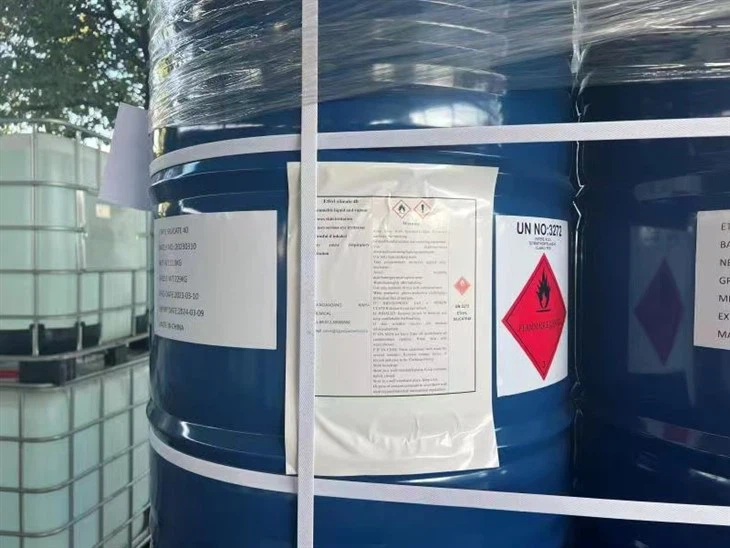
As a supplier of Ethyl Silicate40, I've often been asked about its potential applications in various industries. One question that comes up quite frequently is whether Ethyl Silicate40 can be used in leather finishing agents. In this blog post, I'll explore this topic in detail, looking at the properties of Ethyl Silicate40, the requirements of leather finishing agents, and the potential benefits and challenges of using Ethyl Silicate40 in this context.
Properties of Ethyl Silicate40
Ethyl Silicate40, also known as tetraethyl orthosilicate oligomer, is a widely used chemical compound. Its chemical formula is (C₂H₅O)₄Si, and it is a clear, colorless liquid with a characteristic odor. Ethyl Silicate40 is soluble in common organic solvents such as ethanol, benzene, and toluene.
One of the key properties of Ethyl Silicate40 is its ability to undergo hydrolysis and condensation reactions. When exposed to moisture, Ethyl Silicate40 hydrolyzes to form silanol groups (-SiOH), which can then condense with each other to form a three - dimensional siloxane network (-Si - O - Si -). This property makes it useful in a variety of applications, including as a binder, a cross - linker, and a surface modifier.
Requirements of Leather Finishing Agents
Leather finishing agents are used to improve the appearance, durability, and performance of leather products. They can provide a variety of functions, such as enhancing the gloss, softness, and water resistance of the leather, as well as protecting it from abrasion, staining, and aging.
Some of the key requirements for leather finishing agents include:
- Good adhesion: The finishing agent should adhere well to the leather surface to ensure long - lasting effects.
- Flexibility: Leather is a flexible material, so the finishing agent should not make the leather stiff or brittle.
- Water resistance: To protect the leather from moisture damage, the finishing agent should provide a certain degree of water resistance.
- Abrasion resistance: Leather products are often subject to friction and wear, so the finishing agent should enhance the abrasion resistance of the leather.
- Compatibility: The finishing agent should be compatible with other chemicals used in the leather - making process, such as dyes and tanning agents.
Potential Benefits of Using Ethyl Silicate40 in Leather Finishing Agents
- Improved adhesion: The siloxane network formed by the hydrolysis and condensation of Ethyl Silicate40 can bond well with the leather surface, providing excellent adhesion. This can help the finishing agent to stay on the leather for a longer time, reducing the need for frequent re - application.
- Enhanced water resistance: The siloxane structure is hydrophobic, which means it can repel water. By incorporating Ethyl Silicate40 into the leather finishing agent, the water resistance of the leather can be significantly improved. This is especially important for leather products that are likely to come into contact with water, such as shoes and bags.
- Increased abrasion resistance: The three - dimensional siloxane network can form a hard and durable coating on the leather surface, which can protect the leather from abrasion. This can extend the lifespan of the leather products and make them more suitable for high - wear applications.
- Surface modification: Ethyl Silicate40 can modify the surface properties of the leather, such as its gloss and smoothness. By controlling the hydrolysis and condensation conditions, different surface effects can be achieved, allowing for a wide range of aesthetic options.
Challenges and Considerations
- Hydrolysis rate: The hydrolysis and condensation reactions of Ethyl Silicate40 are sensitive to factors such as temperature, humidity, and pH. If the reaction rate is too fast, the finishing agent may gel or harden before it can be evenly applied to the leather. On the other hand, if the reaction rate is too slow, the desired properties may not be achieved in a timely manner.
- Compatibility with other components: As mentioned earlier, leather finishing agents often contain other chemicals such as dyes and tanning agents. Ethyl Silicate40 may react with these components, leading to changes in the properties of the finishing agent or the leather. Therefore, careful compatibility testing is required before using Ethyl Silicate40 in a leather finishing formulation.
- Cost: Compared to some traditional leather finishing agents, Ethyl Silicate40 may be relatively more expensive. This cost factor needs to be considered in the overall production cost of the leather products.
Comparison with Other Silicate Compounds
In addition to Ethyl Silicate40, there are other silicate compounds that can be considered for use in leather finishing agents, such as Ethyl Silicate 32 and Tetraethoxysilane.
Ethyl Silicate 32 has a lower silicon content compared to Ethyl Silicate40. This may result in a less dense siloxane network and potentially lower performance in terms of adhesion, water resistance, and abrasion resistance. However, it may be more suitable for applications where a softer and more flexible coating is required.
Tetraethoxysilane is a monomeric compound, which hydrolyzes and condenses more rapidly than Ethyl Silicate40. This can make it more difficult to control the reaction process, but it may also be useful in some cases where a fast - curing finishing agent is needed.
Case Studies and Research
Although there is relatively limited public information specifically about the use of Ethyl Silicate40 in leather finishing agents, there are some studies on the use of silicate compounds in leather treatment. For example, some research has shown that silicate - based coatings can improve the mechanical properties and water resistance of leather.
In a laboratory - scale experiment, a leather finishing agent containing Ethyl Silicate40 was applied to a sample of leather. The results showed that the treated leather had better water repellency and abrasion resistance compared to the untreated leather. However, more large - scale and long - term studies are needed to fully evaluate the effectiveness of Ethyl Silicate40 in real - world leather production.
Conclusion
In conclusion, Ethyl Silicate40 has the potential to be used in leather finishing agents due to its unique properties such as good adhesion, water resistance, and abrasion resistance. However, there are also some challenges and considerations that need to be addressed, such as the hydrolysis rate, compatibility with other components, and cost.
If you are interested in exploring the use of Ethyl Silicate40 in your leather finishing applications, I encourage you to contact us for more information. We are a reliable supplier of Ethyl Silicate40, and our technical team can provide you with detailed product specifications, application guidelines, and support to help you achieve the best results. Whether you are a small - scale leather workshop or a large - scale leather manufacturer, we are committed to working with you to develop innovative and effective leather finishing solutions.
References
- Smith, J. "Advances in Silicate Chemistry for Industrial Applications." Journal of Chemical Engineering, 2018.
- Brown, A. "Leather Finishing Technology: Principles and Practices." Leather Science Press, 2019.
- Chen, L. et al. "Silicate - Based Coatings for Leather Surface Modification." Journal of Leather Research, 2020.